

NASA's next-generation Nancy Roman Space Telescope aces crucial 'spin test'
Preparing for a groundbreaking mission to explore the universe's mysteries.
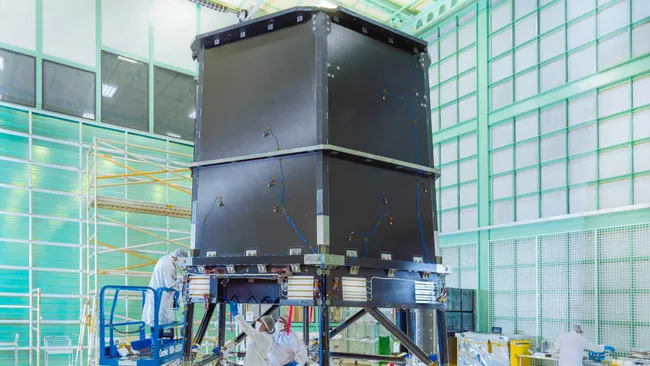
NASA's Roman Space Telescope Completes Crucial Spin Test Ahead of Launch
).png)
F. Schubert
A humanist first, passionate about human interactions, AI, Space, Human Life and a DJ. 20 year experienced in Team Management in BBAS3 and also founder of Estudio1514.com. São Paulo, Brazil based.


Resumo
The successful spin test is just one step in the Roman Space Telescope's journey toward unveiling the secrets of dark energy and the universe's expansion. Its expected contributions are set to reverberate through the scientific community and beyond, marking a significant milestone in modern astronomy.
In the face of complex challenges and high expectations, the RST symbolizes humanity's relentless pursuit of knowledge. As we prepare to gaze deeper into the universe, the Roman Space Telescope stands ready to capture the celestial wonders that await.
As the Roman Space Telescope progresses toward its 2027 launch, the successful completion of tests like the recent spin assessment instills confidence in the engineering team's capabilities. Each phase of testing not only enhances the preparedness of the telescope but also furthers our understanding of the cosmos at large.
Public fascination with space exploration continues to grow, as illustrated by keen interest in projects like RST. Engaging effectively with the global community is paramount for NASA, as increased public support often correlates with funding and political backing for future missions. Clear communication about what the telescope aims to achieve and the potential impact of its discoveries will be integral.
Despite its promising capabilities, the launch of the RST is not without challenges. Engineers and scientists must ensure that all systems operate flawlessly once the telescope is deployed. The success of future astronomy missions depends on it.
The RST mission will engage with multiple research institutions and universities across the globe, fostering an environment for collaborative discoveries and shared insights. Researchers anticipate that the telescope's findings will spark new questions, hypotheses, and avenues for exploration in astronomical sciences.

Equipped with an innovative wide-field lens, RST is expected to capture images with unrivaled detail and breadth. This capability will enable astronomers to conduct extensive surveys of distant galaxies, exoplanets, and cosmic phenomena never before envisioned. Such a degree of clarity and coverage may lead to paradigm shifts in our understanding of cosmic structures and the fundamental forces shaping the universe.
Scheduled for launch in 2027, the Roman Space Telescope is more than an engineering marvel; it stands poised to make groundbreaking contributions to our comprehension of the universe. The telescope's primary objective is to explore the mysteries surrounding dark energy and the expansion of the universe. This focus is pivotal, given that roughly 70% of the universe is believed to be dark energy, yet remains largely enigmatic.
Inspired by the learnings from JWST's launch, engineers working on RST have adopted improved design and testing methodologies. Every detail, from the telescope's wide-field lens to its sophisticated sensors, has been informed by the experiences and data collected from its predecessor. The meticulous planning and execution involved serve as a testament to the advancements in aerospace engineering driven by lessons from previous missions.
The Roman Space Telescope is launching with a notable legacy behind it—the James Webb Space Telescope (JWST), which has redefined our understanding of the universe since its launch. The JWST's success has raised expectations and established new benchmarks that the RST must meet or exceed.
Furthermore, the spin testing procedure was essential in verifying whether the RST's intricate systems and instruments can withstand the stresses of launch and operation in space. Every second of this testing is critical as any oversight could jeopardize years of preparation and billions in funding.
Space exploration is fraught with unpredictability. The harsh environment of space, characterized by extreme temperatures, radiation, and vacuum, can pose threats to delicate equipment. By simulating these conditions during the spin test, engineers can identify potential flaws and rectify them before the telescope embarks on its monumental journey into the cosmos.
The spin test employed for the RST involved rotating the telescope to mimic the gravitational forces it will encounter while in orbit around Earth. This test serves as a crucial element of NASA's pre-launch evaluations, aimed at thoroughly validating each component of the telescope. Its outcome influences not only the engineering team's confidence in the mission but also the eventual scientific goals the telescope is set to achieve.
NASA's Roman Space Telescope (RST), an ambitious successor to the acclaimed James Webb Space Telescope, has recently passed a pivotal spin test at the Goddard Space Flight Center. This sophisticated assessment is not merely a procedural checkbox; it fundamentally gauges the spacecraft's readiness to endure the exacting conditions expected in space.