

Google DeepMind scientists win Nobel chemistry prize
Demis Hassabis and John Jumper honored alongside David Baker for groundbreaking protein research.
Google DeepMind Scientists Awarded 2024 Nobel Prize in Chemistry
).png)
F. Schubert
A humanist first, passionate about human interactions, AI, Space, Human Life and a DJ. 20 year experienced in Team Management in BBAS3 and also founder of Estudio1514.com. São Paulo, Brazil based.


Resumo
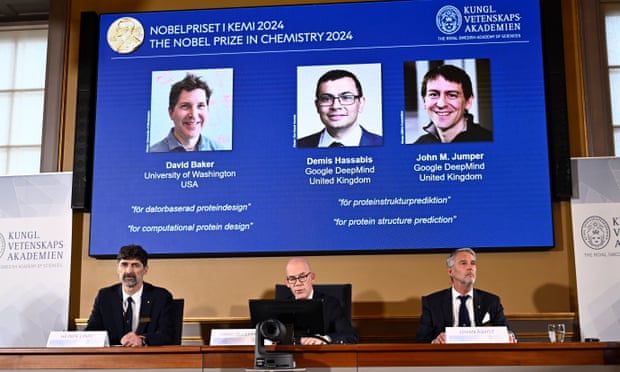
In a remarkable achievement blending the realms of artificial intelligence and biochemistry, two scientists from Google DeepMind have been awarded the 2024 Nobel Prize in Chemistry. This prestigious accolade recognizes their groundbreaking work in predicting and designing protein structures, essential components in numerous biological processes. The Nobel Prize underscores not just academic excellence but the profound impact such advancements can have on medicine, environmental science, and various biotechnological applications. Demis Hassabis, the founder of DeepMind, has been pivotal in driving innovative approaches to complex scientific problems using advanced algorithms. Alongside him, John Jumper, who spearheaded the development of AlphaFold—a cutting-edge protein structure prediction software—shares half of the Nobel prize. The other half is awarded to Professor David Baker of the University of Washington, a pioneer who has developed computational methods to design entirely new proteins, showcasing the limitless potential of computational biochemistry.
The Significance of Protein Structure Prediction
Understanding protein structure is paramount in the field of biochemistry. Proteins, composed of amino acids, are fundamental to life, serving as enzymes, hormones, and structural components of cells. Their functions are intricately tied to their three-dimensional structures. Thus, predicting how a protein folds allows scientists to better understand its function and role within biological systems (Voet & Voet, 2011). As such, the work carried out by DeepMind scientists and Professor Baker brings about a paradigm shift in structural biology. Through the use of machine learning, particularly AlphaFold, researchers have gained the ability to predict protein structures with remarkable accuracy, a task that traditionally required extensive experimental work and specialized knowledge. This advancement not only accelerates research but also democratizes access to protein structure information, making it available to a broader range of researchers capable of innovating new therapies or sustainable biological solutions.
The Era of Computational Protein Design
The announcement by the Royal Swedish Academy of Sciences was met with enthusiasm in the scientific community, confirming that computational methods are not merely auxiliary tools but stand at the forefront of biochemistry (Nobel Prize, 2024). Computational protein design, such as that performed by Baker, allows scientists to create proteins with novel properties. This could lead to the development of new vaccines, enzymes optimized for industrial uses, or even proteins that can capture carbon from the atmosphere. The core methodology involves using algorithms that simulate how proteins fold based on their amino acid sequences. By leveraging vast databases of known protein structures, these algorithms can predict how a sequence will fold, providing insights into its functionality.
Implications of Their Achievements
Health Innovations: Predicting protein structures could lead to faster drug discovery processes. New treatments tailored to combat specific diseases, such as cancer or viral infections, may become accessible in record time.
Environmental Solutions: Engineered proteins could be developed to break down plastics or capture carbon, addressing pressing environmental challenges.
Biotechnology: Industries reliant on enzymes for production processes can benefit from tailored proteins that improve efficiency and effectiveness.
Implications for the Scientific Community
The recognition of such transformative work reinforces the significance of interdisciplinary collaboration in modern science. The intersection of AI and life sciences is paving the way for revolutionary discoveries that were once thought to be unattainable. By sharing the Nobel prize, Hassabis, Jumper, and Baker epitomize how collective efforts can push the boundaries of what is conceivable within chemistry and biology. The collaboration between computational scientists and biochemists may lead to new educational paradigms as well. Emerging scientists must become proficient not only in biological sciences but also in data analysis and machine learning to keep pace with the future of biochemical research.
Conclusion
The 2024 Nobel Prize in Chemistry awarded to Google DeepMind scientists is a clarion call for innovative thinking and technological advancement in the field of protein research. The work of Hassabis, Jumper, and Baker signifies a monumental leap in our understanding and manipulation of life's building blocks. As scientists continue to explore the possibilities offered by computational methods, we may soon witness a new era of breakthroughs that could redefine health, environmental sustainability, and biotechnology. The potential of this work evokes excitement and encourages further investment in research that connects the dots between artificial intelligence and biochemistry.
FAQs
Q: Why is protein structure prediction so important? A: Protein structure prediction is crucial for understanding protein function, facilitating drug discovery, and developing new biotechnological applications.
Q: What is AlphaFold? A: AlphaFold is a protein structure prediction software developed by Google DeepMind that uses machine learning to predict 3D protein structures accurately.
Q: Who else besides Hassabis and Jumper received the Nobel prize? A: Professor David Baker from the University of Washington also received half of the Nobel prize for his work in computational protein design.
Q: What are the applications of designed proteins? A: Designed proteins can be used in various fields, including medicine for drug design, environmental science for pollution reduction, and biotechnology for enhancing industrial processes.
Final Statement The Nobel Prize awarded to Google DeepMind scientists serves as a beacon of hope, illustrating the transformative power of science and technology in addressing some of the most pressing challenges faced by humanity today.