

Curiosity Rover Returns to McDonald Pass: Unlocking Martian Geological Secrets!
Exploring unique zonation patterns that could reshape our understanding of Mars' landscape.
Curiosity Rover Returns to McDonald Pass: Unlocking Martian Geological Secrets!
).png)
F. Schubert
A humanist first, passionate about human interactions, AI, Space, Human Life and a DJ. 20 year experienced in Team Management in BBAS3 and also founder of Estudio1514.com. São Paulo, Brazil based.


Resumo
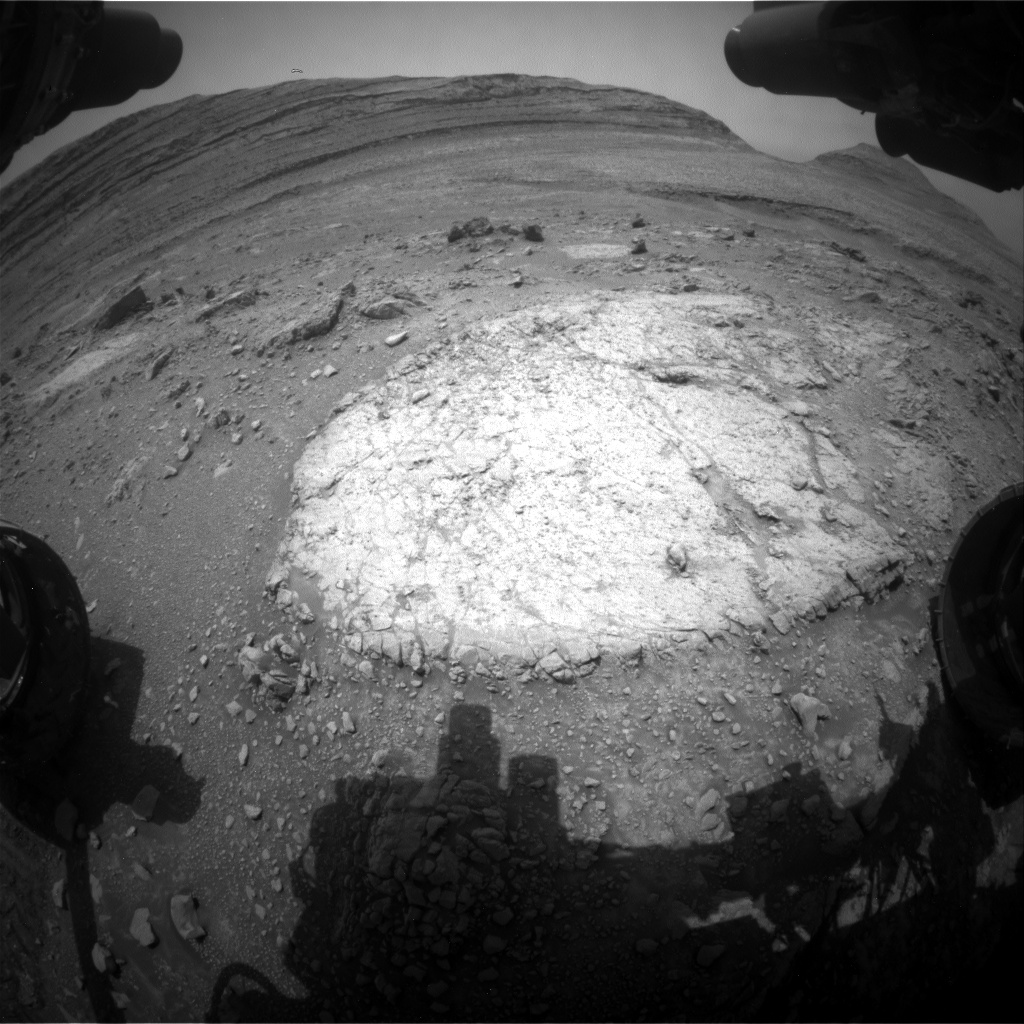
Curiosity, NASA's rover, has made its way back to a location called "McDonald Pass," situated within the Gediz Vallis. This area was first identified about a month ago and has drawn attention due to its intriguing zonation patterns. Zonation refers to the distinct distribution of textures and colors in different areas, which could provide valuable insights into geological processes at play.
By examining the well-defined relationships among the white, gray, and tan materials found at this site, scientists hope to gain a clearer understanding of similar geological formations observed in other regions.
This weekend's drive brought Curiosity back to McDonald Pass, albeit it appears we may have pushed forward slightly too far. The optimal location for studying these zones is directly beneath the rover itself. Therefore, today's operations plan includes contact science, along with a short maneuver to better position the rover for further scientific investigation tomorrow.

The plan for today was unique as it accounted for the U.S. holiday yesterday, resulting in a one-sol operation. I was on duty as the Long Term Planner, which made for a relatively straightforward day once we pinpointed the most effective sites for conducting our contact science experiments.
Our operation commenced with the use of DRT (Dust Removal Tool) and APXS (Alpha Particle X-ray Spectrometer) on the central slab area, targeting a site dubbed "Erin Lake." Following that, we initiated a remote sensing block focusing on environmental monitoring tasks such as searching for dust devils, measuring atmospheric opacity, and tracking fine particulate movement on the rover's deck.
One notable component of the Geology Theme group's plan includes utilizing ChemCam LIBS (Laser-Induced Breakdown Spectroscopy) on the darker gray rim of the block known as "Paris Lake." Additionally, the team has identified an interesting dark float block nearby for passive observation using ChemCam. A long-distance RMI (Remote Micro-Imager) mosaic is also in progress to assess the yardang unit situated higher on Mount Sharp, while a Mastcam mosaic will help evaluate the textural details in a series of large clasts.
In the afternoon, Curiosity is scheduled to take MAHLI (Mars Hand Lens Imager) images of both Erin Lake and another target, "Picture Puzzle," which captures the intriguing relationships between the white, gray, and tan zones. Following these observations, the rover will execute a short drive back approximately 1 meter (around 3.3 feet) to place a white and gray clast within our workspace, allowing for more contact science efforts tomorrow.
Is McDonald Pass the pivotal location for deciphering the zonation phenomena observed across various blocks in this region? Stay tuned for updates.