Illusion of a Lifetime: Comet Tsuchinshan-ATLAS Wows with an Unexpected Second Tail
A stunning optical phenomenon captures the imaginations of skywatchers and astronomers alike.

Illusion of a Lifetime: Comet Tsuchinshan-ATLAS Wows with an Unexpected Second Tail
).png)
F. Schubert
A humanist first, passionate about human interactions, AI, Space, Human Life and a DJ. 20 year experienced in Team Management in BBAS3 and also founder of Estudio1514.com. São Paulo, Brazil based.


Summary
Rare illusion gives 'once-in-a-lifetime' comet a seemingly impossible 2nd tail after closest approach to Earth for 80,000 years
A stunning optical phenomenon captures the imaginations of skywatchers and astronomers alike.
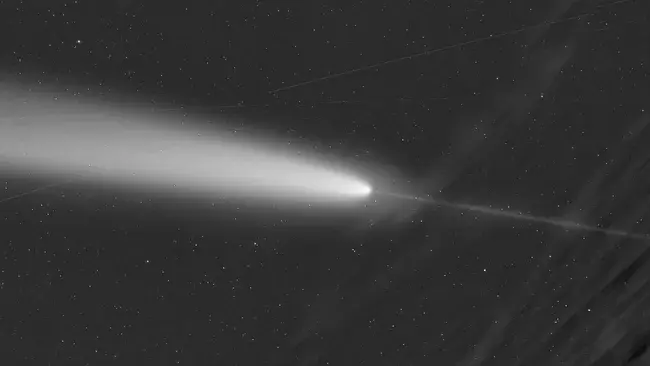
A rare comet that passed closer to Earth than any other comet in 80,000 years has seemingly developed an impossible second tail in a mind-bending optical illusion.
Comet Tsuchinshan-ATLAS (C/2023 A3), which was discovered in early 2023, made its closest approach to Earth on Oct. 12, passing within 43.9 million miles (70.6 million kilometers) of our planet — around 180 times the average distance between Earth and the moon.
The comet, which likely orbits the sun every 80,660 years, became visible to the naked eye after slingshotting around the sun in late September. On Oct. 14, astrophotographer Michael Jäger captured stunning images of the comet near Martinsberg, Austria, which showed not only the comet's prominent tail but also an elusive phenomenon known as an "anti-tail."
Enhanced versions of the images show the anti-tail as a faint streak extending in the opposite direction from the comet's traditional tail.
A comet's tail, which is made up of dust and gas that has been stripped away from the comet's icy core, or nucleus, by solar radiation, always points away from the sun. This means that observers on Earth normally only see one prominent tail.
However, when Earth passes through a comet's orbital plane, which happened over the weekend, sunlight can illuminate a thin sheet of dust that has recently been shed by the comet. This dust reflects light back toward Earth, creating the illusion of a second tail pointing toward the sun — hence the name "anti-tail."
Anti-tails are not unheard of. In January, the green comet C/2022 E3 (ZTF) developed an anti-tail as it made its close approach to Earth. And in June, Comet 12P/Pons-Brooks, also known as the "devil comet," displayed its own anti-tail as it approached Earth.
Unfortunately, Comet Tsuchinshan-ATLAS's brightness is already starting to fade as it drifts away from Earth and back out to the far reaches of the solar system. However, keen-eyed skywatchers may still be able to spot the comet with a good pair of binoculars or a small telescope over the next few days.
Stargazers can use websites like TheSkyLive.com to find out when and where the comet will appear in the night sky.
Another "sungrazer" comet was recently discovered and may be visible later this month as it approaches Earth for a close swing around the sun. However, observations suggest the comet may break apart before it reaches us.