

Half-a-billion-year-old 'marine Roomba' is earliest known asymmetrical animal
At 555 million years old, _Quaestio simpsonorum_ reveals critical insights into the evolution of life.
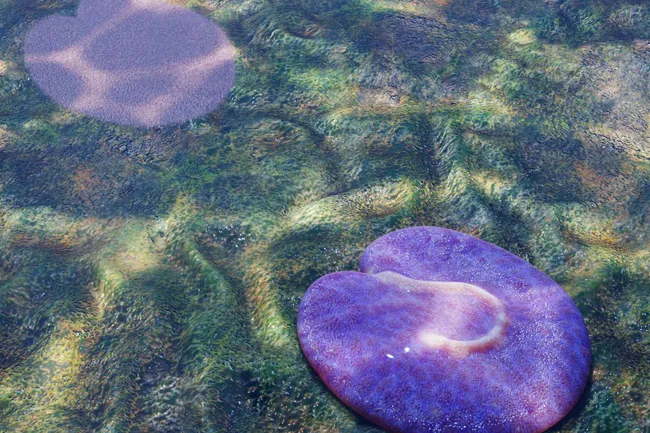
Earliest Known Asymmetrical Animal Found in Australia
).png)
F. Schubert
A humanist first, passionate about human interactions, AI, Space, Human Life and a DJ. 20 year experienced in Team Management in BBAS3 and also founder of Estudio1514.com. São Paulo, Brazil based.


Summary
Half-a-billion-year-old 'marine Roomba' is earliest known asymmetrical animal
At 555 million years old, Quaestio simpsonorum reveals critical insights into the evolution of life.
The earliest known animal with an asymmetrical body lived 555 million years ago and resembled a "marine Roomba," new research reveals.
The creature, named Quaestio simpsonorum, was discovered in South Australia's Nilpena Ediacara National Park and belonged to a group of organisms known as the Ediacara biota — some of the earliest known complex lifeforms on Earth.
"It's about the size of the palm of your hand, shaped like a shield with a large backward question mark-shaped protrusion," Scott Evans, a paleobiologist at Florida State University and first author of the study, told Live Science. "This protrusion is the first evidence we have in the fossil record of asymmetry in animals."
This asymmetry is a significant evolutionary development, as it indicates that the creature's body was organized in a way that distinguished its left and right sides — a feature that is common in many modern animals, including humans.
"Asymmetry allows for the development of specialized organs," Evans said. "In humans, for example, our heart is on one side of our body and our liver is on the other."
The discovery of Q. simpsonorum pushes back the timeline for the evolution of asymmetry in animals by millions of years. Previously, the earliest known asymmetrical animals dated to around 540 million years ago, during the Cambrian explosion — a period of rapid evolutionary diversification.
The fossil record shows that Q. simpsonorum was mobile, with tracks preserved behind one specimen. This suggests that the creature moved along the ocean floor, potentially feeding on microscopic algae and bacteria.
"It's kind of like a marine Roomba," Mary Droser, a paleontologist at the University of California, Riverside and co-author of the study, said in a statement. "It's moving along the sea floor, vacuuming up microbes as it goes."
The researchers believe that Q. simpsonorum's unique body shape and mobility may have given it an advantage in its environment, allowing it to access food sources that were unavailable to stationary organisms.
The study of Q. simpsonorum and other Ediacaran organisms is crucial for understanding the evolution of complex life on Earth. These ancient creatures provide insights into the developmental processes that led to the diverse array of animal life we see today.
"The genetic programming that creates bilateral symmetry in modern animals is the same across all groups," Evans said. "It's likely that Quaestio was using aspects of this same genetic programming."
Understanding Earth's evolutionary history could also have implications for the search for life on other planets.
"If life is unique to Earth, we should use what we know about how it unfolded here to guide our search elsewhere," Droser said. "And if it's not unique to Earth, understanding our own evolutionary history can help us recognize life on other planets."
The research was published on Oct. 17 in the journal Proceedings of the Royal Society B.
Originally published on Live Science.