

Arctic and Antarctic Sea Ice Approached Historic Lows
Arctic and Antarctic Sea Ice Approaches Record Lows, Reinforcing Urgent Need for Climate Action

Historic Sea Ice Loss in Polar Regions Signals Climate Emergency
).png)
F. Schubert
A humanist first, passionate about human interactions, AI, Space, Human Life and a DJ. 20 year experienced in Team Management in BBAS3 and also founder of Estudio1514.com. São Paulo, Brazil based.


Summary
The specter of climate change looms large over our polar regions, with Arctic sea ice retreating to alarming lows, marking another year in a concerning trend. On September 11, 2024, researchers from NASA and the National Snow and Ice Data Center (NSIDC) reported that the Arctic sea ice had reached a minimum extent of 4.28 million square kilometers (1.65 million square miles), descending about 1.94 million square kilometers (750,000 square miles) below the average from 1981 to 2010 (NSIDC, 2024). This dramatic decline is part of a broader pattern that highlights not only the fragility of our environment but also the cascading impacts of climate change on ecosystems and communities.
The Decline of the Arctic Sea Ice
Historically, the Arctic experiences seasonal fluctuations in sea ice cover as it melts and regrows throughout the year. Over the past 46 years, a clear pattern has emerged: summer melting is more pronounced and winter ice formation is increasingly minimal. These changes have profound implications for Arctic wildlife, local communities, and global trade routes. Tracking these real-time shifts has become essential to comprehensively understanding how the Arctic reacts to ongoing global warming (Young, 2024).

The recent melt underscores a significant environmental crisis. This year's sea ice minimum places it as the seventh lowest in the satellite record, still noticeably higher than the all-time low of 3.39 million square kilometers (1.31 million square miles) recorded in September 2012. Despite these fluctuations, ice extent has been on a downward trajectory since satellite observations began in the late 1970s, with an annual loss rate averaging approximately 77,800 square kilometers (30,000 square miles) (NSIDC, 2024).
Changes in Ice Composition
Adding another layer of complexity to this issue is the changing composition of the ice itself. Nathan Kurtz, chief of the Cryospheric Sciences Laboratory at NASA's Goddard Space Flight Center, emphasizes that most of the ice now in the Arctic Ocean is younger and thinner—first-year ice that struggles to endure warmer weather (Kurtz, 2024). This shift in composition poses further risks since first-year ice is less resilient against the heat of summer.
Measurements from NASA's ICESat and ICESat-2 satellites reveal a dramatic decrease in thickness, with current fall sea ice hovering around 1.3 meters (4.2 feet) versus the peak of 2.7 meters (8.8 feet) reached in 1980. This thinning ice not only presents challenges for marine life but also complicates local traditional practices dependent on stable ice conditions.
Antarctica: Following a Similar Pattern
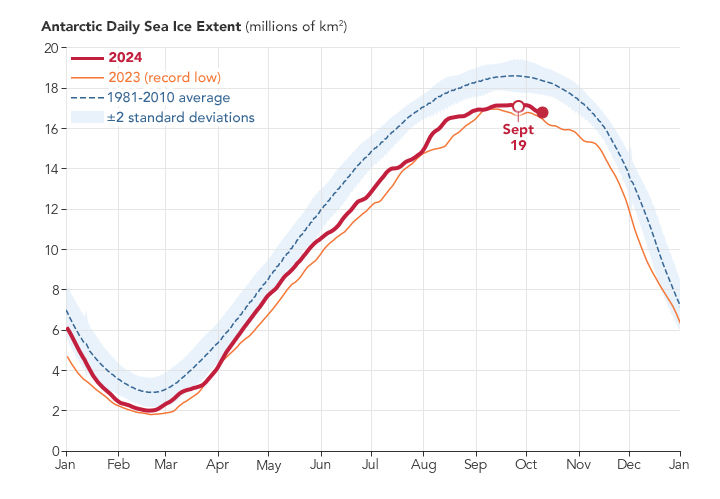
Interestingly, the southern polar region is not immune to these changes either. Scientists observed near-record-low sea ice around Antarctica in 2024, a stark contrast to what is typically expected during the Southern Hemisphere's cold months. The maximum extent of sea ice reached 17.16 million square kilometers (6.63 million square miles) on September 19, 2024, marking it as the second lowest in recorded history, trailing the previous year's minimum of 16.96 million square kilometers (6.55 million square miles) (NSIDC, 2024).

Before 2014, Antarctic sea ice was gradually increasing by around 1 percent per decade. However, since that year, the trend has reversed, with scientists racing to understand the root cause of this shift (Meier, 2024). This alteration is believed to hint at long-term changes in the Southern Ocean's conditions, influenced by advancing climate change.
The Ice-Albedo Feedback Mechanism
Both polar regions highlight a concerning concept: the ice-albedo feedback loop. Bright sea ice effectively reflects the sun's energy, whereas exposed ocean absorbs approximately 90 percent of it (Kurtz, 2024). This absorption subsequently warms ocean water and delays the formation of new ice during winter. The cyclical nature of this phenomenon exacerbates the rise in global temperatures and can lead to additional, severe consequences if left unchecked.
Evidence supports that the loss of ice not only increases temperatures locally but contributes to the significant warming experienced in the Arctic, which has risen about four times faster than the global average (Kurtz, 2024).
Impacts on Ecosystems and Communities
The repercussions of diminishing sea ice extend beyond numerical data points; they ripple outwards, affecting polar wildlife, indigenous populations, and even international shipping routes. Habitat loss for species such as polar bears and seals disrupts the delicate balance of these ecosystems, endangering species that rely on stable ice cover for survival.
Local communities, often Indigenous Peoples, face challenges as traditional hunting and fishing practices become unsustainable amid changing conditions. With melting ice opening new trade routes, this could lead to increased shipping traffic, which may threaten marine life and alter existing ecosystems irrevocably.
The Global Call to Action
As the alarming data showcases the diminishing state of both Arctic and Antarctic sea ice, the persistent narrative surrounding climate change must be acted upon globally. Policymakers, scientists, and society at large need to engage actively in mitigating climate change implications.
It is imperative for communities to advocate for stronger climate action frameworks and support sustainable practices that promote restoration and protection of polar environments. Collaboration across borders will be essential, as the consequences of these environmental challenges are not contained by geopolitical boundaries
In essence, as we approach historic lows for sea ice in the Arctic and Antarctic, the world must confront the truths presented by our planet's changing climates. Our collective actions can either mitigate these impacts or allow them to escalate dramatically.
Frequently Asked Questions
What is the significance of sea ice measurement? Measuring sea ice extent is crucial for understanding climate change impacts and predicting future environmental shifts. Changes in sea ice affect weather patterns, global sea levels, and marine biodiversity.
How does the loss of sea ice affect wildlife? Loss of ice diminishes habitat for marine species and disrupts food chains, leading to potential declines in species populations such as seals and polar bears, which are adapted to icy conditions.
What can be done to reverse this trend? Policy changes focusing on reducing greenhouse gas emissions, promoting renewable energy, and enforcing stricter regulations on shipping and industrial activities in polar regions are pivotal steps toward reversing these trends.